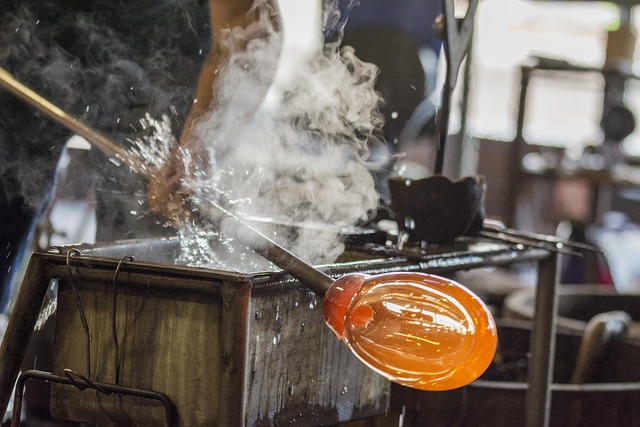
The furnace changes everything
Most craft workshops are relatively calm environments. There's movement, decision, sometimes significant physical effort — but the pace is set by the maker, and there are pauses. You can think between moments. A glassblowing workshop doesn't work like that. The material decides the pace, and the material is at 1,150 degrees Celsius and cooling the second it leaves the furnace.
I spent three days at a studio in southern Bohemia in January. The workshop had been operating continuously for twenty-two years in the same space — a converted agricultural building with a furnace that takes four days to reach working temperature and is never fully extinguished during the season.
The physical environment was unlike any workshop I'd photographed before. The ambient temperature was around 35 degrees even in winter. The furnace itself was a sustained roar at one end of the room. Every surface within a few metres of it was blackened.
The problem of documenting something you can't slow down
Glass at working temperature is malleable for roughly thirty to ninety seconds per gather, depending on mass and ambient temperature. A skilled blower can do a great deal in that window. They can also lose the piece entirely if a single step goes wrong, and starting again means another trip to the furnace and another thirty-second clock.
Photographing this requires a different kind of attention than most process documentation. In a pottery, you can shift position between pulls. In a weaving studio, the weft goes in slowly enough that you have time to think about where to stand next. In a glassblowing workshop, the interesting moment arrives before you're ready for it.
By the end of the first day, I'd shot a great deal of technically reasonable images of glass at the wrong moment. The moment when it was shapeless, or just shaped, or cooling into rigidity. What I hadn't managed was the moment in the middle — when it was neither liquid nor solid, when the blower was making the decision that would determine the final form.
"The glass tells you when it's ready. The job is to be looking at the right time."
What three days teaches that one couldn't
By the end of the second day, I had stopped trying to anticipate and started following. Rather than positioning myself for the moment I thought was coming, I kept the glassblower in frame and moved with them — a continuous shift of position that meant I was almost never perfectly placed but never completely wrong.
The images from the third day are different from the images from the first. Not technically — the exposure, focus, and composition are comparable across all three days. What changed was the information in the images. The third day's images show decisions. The first day's images show actions.
Notes on heat and equipment
A practical note that isn't in most writing on this subject: furnace heat affects lenses. I noticed the first day that images taken at close range to the furnace mouth had a slight distortion that wasn't present in the same glass used in other environments. It's caused by heat shimmer in the air column between the lens and the subject — the same effect that distorts road surfaces on hot days, compressed into a few metres.
Working further back and cropping in post eliminated this. It also meant less intimate framing, which was a genuine trade-off. For most of the commissions I'd take in a glassblowing context, I'd accept that trade-off rather than try to work at furnace distance.