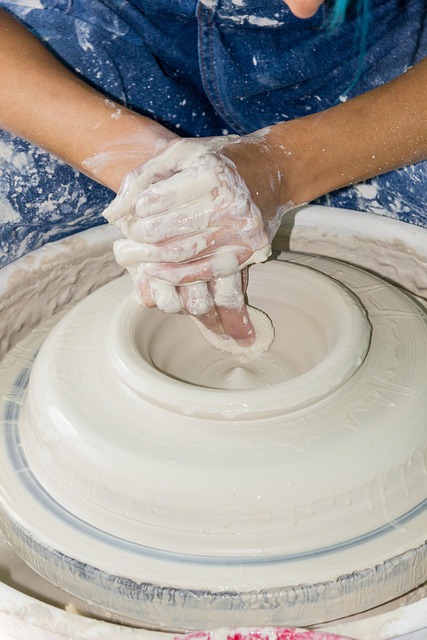
Arriving before the clay is ready
I arrived at a pottery in the Loire valley at seven in the morning, two hours before the session was formally scheduled to begin. The potter, a man in his sixties who had been working in the same building for thirty-four years, was already there. He'd been there since six.
He wasn't making anything yet. He was preparing clay — wedging, assessing moisture, cutting sections and recombining them. It's the part of the process that almost never gets photographed because it doesn't produce anything visible. There's no object taking shape, no dramatic transformation. Just hands moving through a grey mass in a systematic way.
Those two hours produced some of the clearest images I've made of how pottery actually works, because they showed the preparation that makes the throwing possible. Every piece that came off the wheel that day began in those hours I almost didn't stay for.
The half-day problem
Most commissions ask for a half-day session. This is reasonable — it's what fits into a schedule, it's what most clients can accommodate, it's what the budget supports. For some work, it's enough.
For pottery specifically, it's almost always inadequate. Not because of the time required to make things — a skilled thrower can produce a significant body of work in four hours — but because of the time required to understand what you're watching.
Pottery moves slowly enough that it looks simple until you've watched it long enough to see what's actually difficult. A half-day session puts you in the room for long enough to shoot the surface. A full day puts you there long enough to begin to understand the decisions underneath it.
"You can't photograph what you don't understand well enough to recognise."
What a day of watching teaches
The specific thing I learned, watching this particular potter across a full working day, was the difference between the throws that worked and the throws that didn't — and the fact that from a distance, they looked identical until the moment of failure.
He threw forty-seven pieces that day. I counted, not because the number matters, but because it was the first time I'd counted and realised I couldn't tell from looking which ones he'd discard. The rejects went back into the wedging process without ceremony. No visible frustration, no change of pace. Just a return to the beginning.
That information changed the images I made in the afternoon. I started shooting differently — looking for the decision points rather than the moments of obvious skill, trying to find what the choice looked like rather than what the successful execution looked like.
A practical note about scheduling
If you're considering a commission and the budget or schedule requires a half-day session: this isn't necessarily a reason to not proceed. A half-day session with a single well-understood focus — one stage of the process, one type of object, one specific technical sequence — can produce excellent images. The problem arises when a half-day is expected to produce what a full day would produce.
Being clear about this upfront produces better work than discovering it partway through a session when the time is mostly gone.